
















































When a ‘pregnant man’ appears and how to treat it: how and why the steering column wiring harness breaks
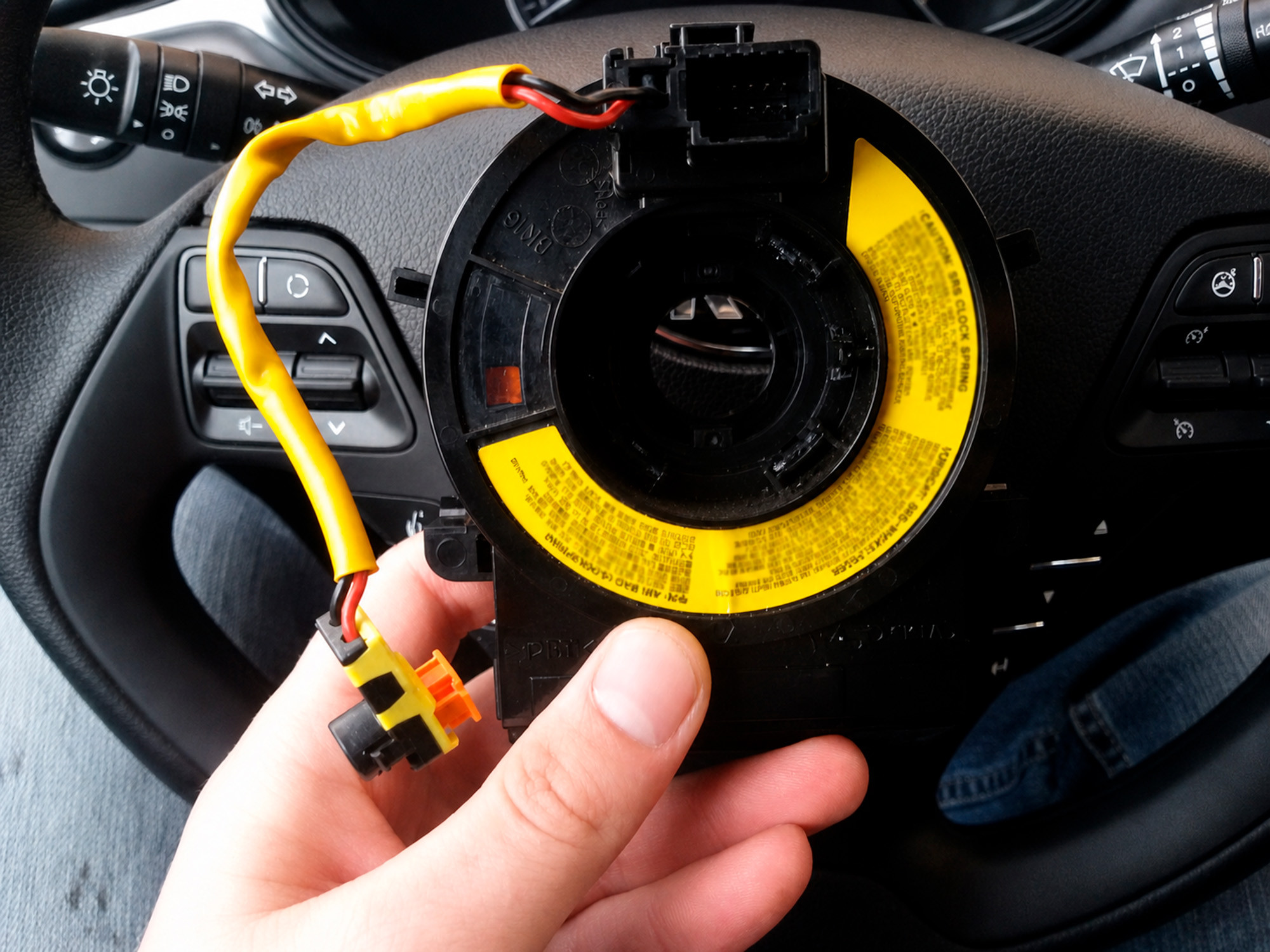
Back when trees were big and the only electrical component on the steering wheel was the horn, no one could have even imagined the so-called “clock spring” (also known as the clockspring, steering column spring, or “snail”). But time passed, technology advanced, buttons appeared on the spokes, and an airbag settled into the hub. To ensure all these electrical components worked correctly, a device was needed that could provide uninterrupted power and signal transmission in any position of the steering wheel. That device became the clock spring. Today, we will talk about the typical signs of its failure and repair possibilities.
Spin and twist, contact won’t miss
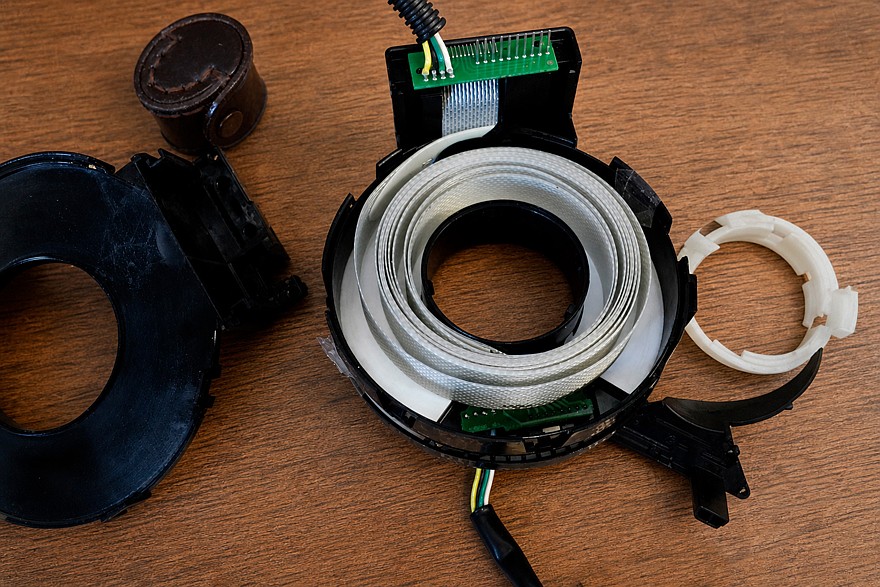
The clock spring used in modern cars is a fairly standard and simple product. To ensure uninterrupted power supply and signal transmission between components on the rotating steering wheel and the stationary electrical equipment and electronics on the steering column and in the cabin, it is made in the form of a spirally wound electrical wire. Typically, this is a flexible flat (ribbon) multi-core cable with several conductive tracks, housed in a special casing. It looks like a classic clock spring from mechanical timepieces (in other words, a torsion spring), after which it is named. But unlike it, it does not compress, storing energy for subsequent release when unwound, but simply twists in a similar manner.
The operating principle is elementary. The cable is wound so that when the steering wheel is turned in one direction or another, the steering column ribbon cable unwinds or winds up without losing stable electrical contact between the connected elements. This means that in any position, as well as during rotation, the critically important connection is maintained between the airbag and the SRS (Supplemental Restraint System) control module, between the stereo and its control buttons on the spokes, between the horn and the horn button, and other components.
If ordinary wires were placed there, they would inevitably get tangled, frayed, and break very quickly, but the flat ribbon shape and precise spiral winding protect the clock spring from damage. However, nothing lasts forever under the moon, and even steering column ribbon cables made from very reliable materials can fail.
Psychopaths behind the wheel
This usually happens for several reasons. The main one, of course, is natural wear and tear. Initially, clock springs are designed for quite a long service life, comparable to the lifespan of the vehicle. But different people handle the steering wheel differently. You’ve probably noticed this yourself. Some people maneuver smoothly and calmly, while others, as if in a hysterical fit on a track, yank the wheel furiously, with immense force, sharply changing direction. Not only do they spin it, but they seem to try to tear it out by the roots, performing an act of sacrifice to the automotive deity. This is hard enough for other road users to perceive, so imagine how difficult it is for the clock spring.
People also sound the horn in their own way. Some just need a gentle press, while others pound it with all their might, spewing curses into the well-insulated abyss of the passenger cabin.

Add to all these nervous jerks and impacts the natural negative factors like winter freezing and summer heat, glitches in the onboard electrical network, and other adverse conditions that are abundant in ordinary automotive life. As a result, the steering column ribbon cable wears out at an especially intense rate and fails noticeably earlier than its intended lifespan.
Manufacturing defect
The second most common cause is plain old factory defect. You might be surprised, but it happens quite often even with such a structurally simple component. Some cases are promptly uncovered by the manufacturer’s quality control, leading to recall campaigns. For example, at the end of 2020, Mercedes-Benz conducted a recall related to the steering wheel wiring, and in 2023, Lada did the same. The Togliatti-based company issued directive No. 110-23, according to which, due to intermittent operation of turn signals and windshield wipers, the entire steering column switch module assembly, including the “snail,” had to be replaced.
It’s worse when such cases go unnoticed by the brand. Now, probably few people remember that at one time, many Nissan owners experienced specific problems with the steering column ribbon cable. Especially on the Qashqai and Tiida. It seems they eventually managed to overcome the issue with minimal damage, but the unpleasant aftertaste lingered for a long time. On facelifted Mercedes-Benz W204 models, something was also amiss, and the Subaru Forester SJ also didn’t cover itself in glory.
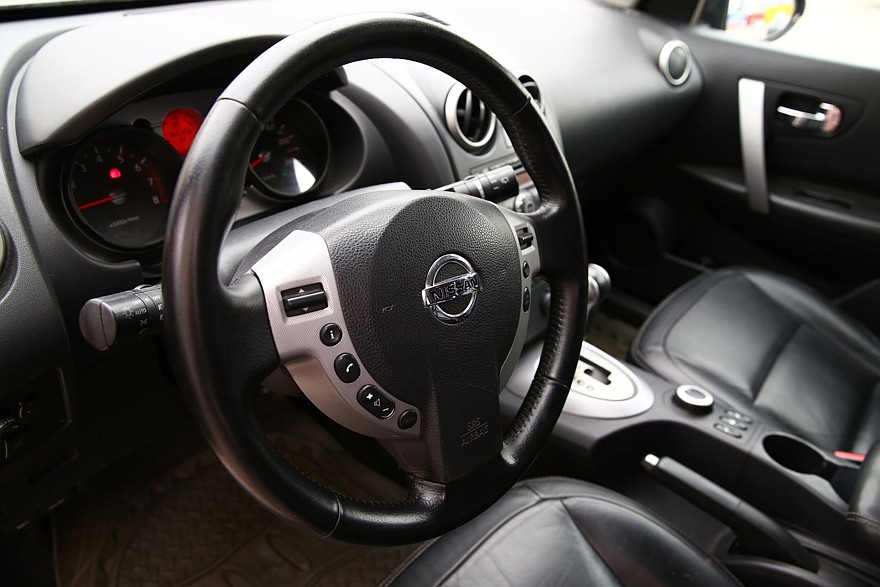
In short, such problems are not a unique absurdity. They are characteristic of all brands, and honestly, we shouldn’t blame the automaker for them. The fact is that the clock spring module itself is produced by third-party companies – they almost always remain in the shadows, and the well-known automotive brand has to pay with its reputation in case of their “blunder.” However, the brand isn’t entirely absolved of blame – it failed to oversee what it should have. After all, it provides the customer with a finished commercial product – the car.
External contamination
It’s not that the clock spring is wide open to all winds and storms, but for obvious reasons, it doesn’t have any special airtightness with a high degree of isolation from external intrusions. This leads to various contaminants actively entering it during operation, including moisture, which can be introduced if the car’s cabin also has issues with sealing.
Of course, none of this benefits the ribbon cable. Contacts can start to corrode, and the wiring itself can wear out due to the abrasive effect caused by the ingress of small particles: dust, debris, sand grains. In other words, we are dealing with a very clear illustration of the old good rule: cleanliness is the key to health. In this case, automotive health.
Articles / Used Cars Nissan Qashqai I with mileage: rust in the trunk and cheap leatherette The Qashqai was not the first, not the second, and not even the tenth crossover in the history of the global auto industry. By the time this model was released, some companies had been producing SUVs for over 10 years. And yet this… 17665 1 22 19.08.2020
It happens too
In the last group, we combined two rarer but still occurring causes. The first is physical damage to the steering column ribbon cable, up to complete destruction due to an accident or road traffic incident. Undoubtedly, for this to happen, strong arguments in the form of destructive forces are needed, and sometimes, unfortunately, they occur.
The second is errors during installation or repair, which also often render the clock spring unable to perform its functions. This is also clearly not an ordinary event. But you cannot be completely insured against it either – precedents are known. Therefore, it cannot be dismissed as a possible cause.
Now let’s move on to the signs of malfunction.
Error and dead buttons
The most obvious sign of a malfunction is the SRS system warning light (that “pregnant man” icon) illuminating when the engine is started and not going out after the prescribed time. This often causes immediate panic: people think the airbags themselves have failed, but experience shows that in almost 90% of cases, it indicates not a failure of the airbags, but some glitches in the supporting electronics or electrical systems. According to professional experience, the steering column ribbon cable accounts for the lion’s share of such activations.
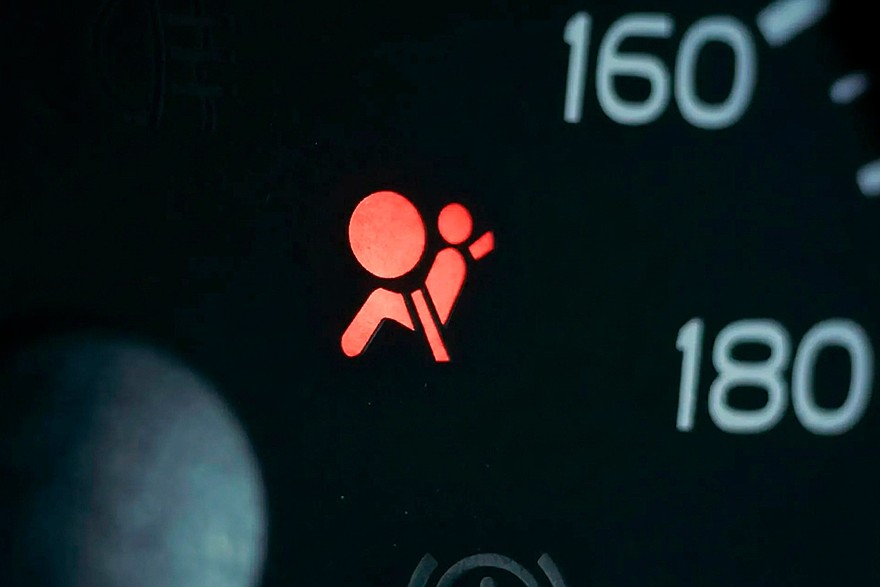
Will the airbags fail to deploy in an accident because of this? A question with a non-obvious answer. Many manufacturers design algorithms so that minor faults do not interfere with the execution of primary functions in critical situations. But there are also those who completely deactivate the system when any related errors enter the control unit’s memory. Even very indirect ones.
So, in each specific case, the scenario will be individual. Actually, this is precisely why it is not entirely correct to determine the serviceability of the airbags and prohibit the operation of the vehicle when the SRS warning light is on. The problem might simply be in the steering column ribbon cable, and the safety system algorithm might “swallow” this error, not considering it significant and deploying the airbags when the situation demands it.
However, we have digressed a bit. Let’s get back to the main point. So, a constantly lit “pregnant man” on the dashboard is one of the main signs of a faulty clock spring. There’s no need to panic. You need to read the error codes and only after establishing an accurate diagnosis, deliver the final verdict.
The fact that constantly lit (or flashing) pictograms of the anti-slip regulation system or the electronic stability program can also indicate problems with the clock spring’s communication further speaks to the intricacies of electronic algorithms and their lack of uniformity across different auto brands. They show that the steering column ribbon cable has lost the ability to correctly transmit information between the steering wheel and the corresponding vehicle control modules.
Here, the sequence of actions is similar – read the error codes and draw conclusions. You can never rule out that the ribbon cable, as in the previous case, is not involved.
A more obvious, but less frequently identified sign is malfunctioning buttons and switches on the steering wheel. This also includes a non-working horn (which, by the way, is a quite objectively diagnosable prohibition on operating the vehicle). Unlike the cases described above, this is almost certainly (if several keys are glitching at once) due to disruptions in the electrical connections within the steering column ribbon cable.
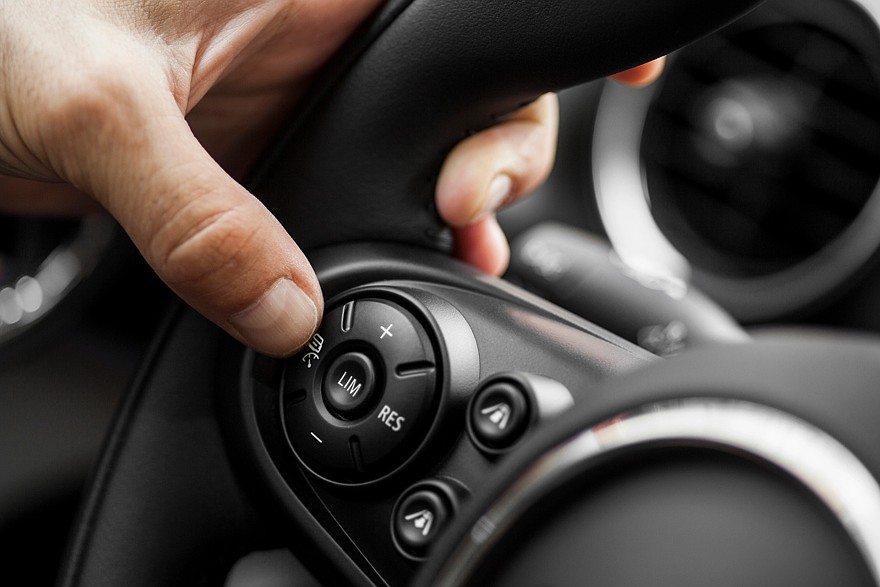
Such symptoms may not always appear, but only under certain conditions. For example, when turning the steering wheel 180 degrees, when you are holding the lower part of the wheel particularly tightly, or in some other situations. Be sure to pay attention to such nuances – they are very helpful in correctly diagnosing the problem.
Additionally, pay attention to the effort required to turn the steering wheel. If it is greater than usual, it is possible that the ribbon cable has torn or frayed, and its particles are creating obstacles to normal rotation. The rotation may also be accompanied by an extraneous sound – a more or less loud squeaking or grinding noise. The noise occurs because metal pieces of the cable or plastic fragments of the braid or tape come into contact with each other or with the steering wheel when it is turned. All of this is also not good.
Repair or replacement
What can be done? There are two options – repair or replacement. The first is for the strong-willed, those who feel they have considerable talent and ability. But even they are strongly advised, before starting work, to search online for materials about the steering column ribbon cable specifically for their car’s make and model. Despite the standard nature of the technology, certain nuances can always arise, which are better to familiarize yourself with “before” rather than “during.”
And, of course, you need to worry about finding spare parts in advance – at least to understand if they exist. Most often, the ribbon cable itself – the flat cable – needs to be replaced. You can find it yourself or select one based on advice from more experienced owners of the same car model.
Furthermore, you might be surprised to learn that ribbon cables from printers often fit. The ones that go to the print heads. However, you will likely have to “adapt” them slightly for this unconventional application. But there is also plenty of information on how to do this in car owner forums.
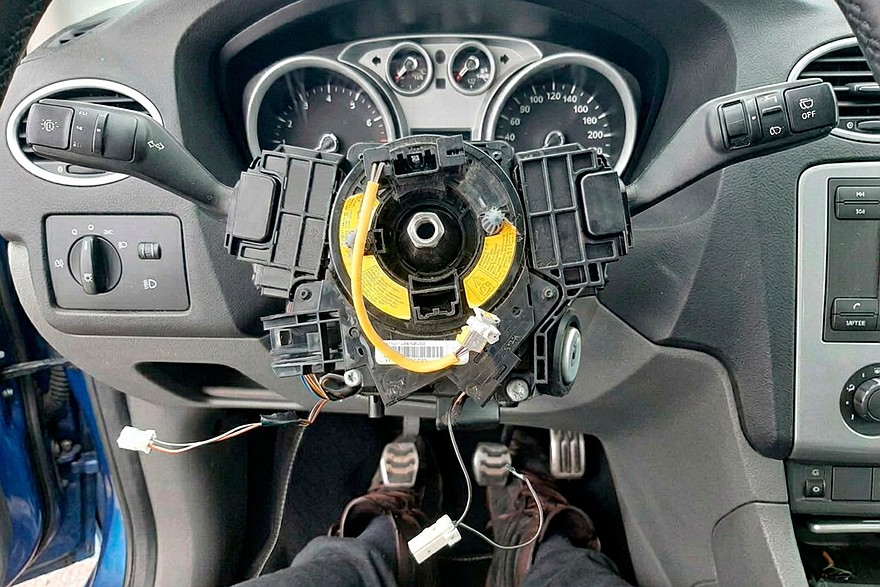
With contact groups, ordinary wires, and everything else, it’s simpler – you can select them based on what is used in your car.
But the most sensible thing is still to buy a new clock spring assembly. It is usually inexpensive. And it is generally easy to find in catalogs. This way, you will have complete confidence that everything will work correctly after the repair. Keep in mind that besides the obvious functions (horn, stereo control, and everything else), some car models may also take the steering wheel angle into account for calculating traction or stability control. Therefore, the repair must be performed flawlessly. This means that before you dive into the steering wheel yourself, weigh all the pros and cons a hundred times: maybe it’s still better to entrust the troubleshooting to professionals?