

































Tesla FSD Driver Monitoring Bypassed by Chinese-Made ‘Dummy
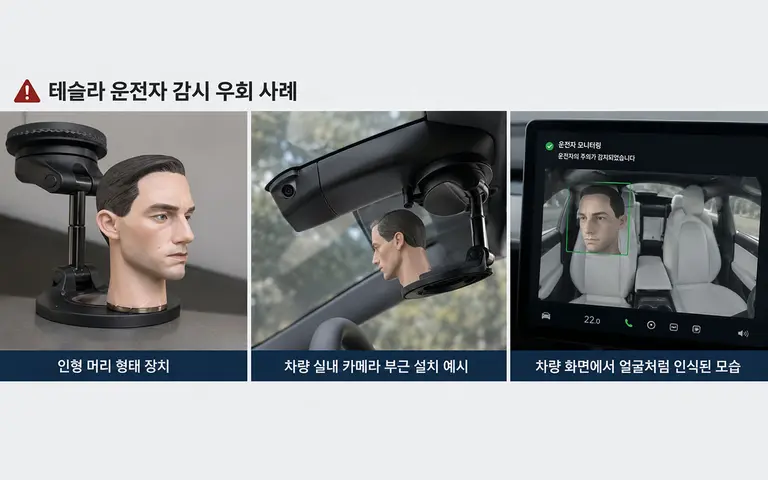
Various tricks to fool Tesla’s driver monitoring system are spreading in China. The vehicle determines that the driver is watching the road ahead, but in reality, the driver is looking at their phone or closing their eyes, leaving driving entirely to the driver assistance feature, which has become a problem.
The core of the issue lies in Tesla’s driver monitoring method. Tesla’s FSD, or Full Self-Driving, is not fully autonomous driving, contrary to consumer beliefs. Tesla also describes it as a “supervised” feature, stating that the driver must be ready to take over steering and braking at any time.
Tesla uses an interior camera and steering wheel torque detection to confirm the driver’s attention level. However, this case shows that this monitoring system can be vulnerable to physically disguised objects.
The devices used in China are small plastic head ornaments that mimic famous actors or celebrities. Some products are close to simple figurines, while others are designed to make the driver monitoring camera mistake them for a human head or face. These products are being traded on Chinese e-commerce platforms such as Taobao, Xianyu, and Douyin for around $10 to $40.
This is not the first attempt to deceive Tesla. In the past, weights were attached to the steering wheel to make the vehicle mistakenly believe the driver was holding the wheel. Some drivers used sunglasses or camera-blocking devices to evade the interior camera’s eye tracking, and in particular, cases of leaving the driver’s seat empty or using Autopilot while sitting in the rear seats have also been problematic.
In China, in addition to these doll heads, it has been reported that photos of human faces, printed materials that appear to blink, and small screens playing looped videos have also appeared.
The U.S. National Highway Traffic Safety Administration raised concerns in 2023 about whether Tesla’s Autopilot driver monitoring and misuse prevention measures were sufficient, and Tesla conducted a software update recall covering more than 2 million vehicles in the U.S. Since then, controversy has continued over whether Tesla’s driver monitoring system is adequate. This case in China reveals that software updates alone cannot completely prevent intentional misuse by drivers.
Compared to trends in the broader automotive industry, Tesla’s approach is also controversial. Some manufacturers combine multiple devices, such as infrared cameras, eye tracking, hand position detection, and capacitive steering wheel sensors, to assess driver attention. In contrast, Tesla has strongly pushed a camera-centric vision system. However, while the camera-based approach has advantages in cost and scalability, concerns have been raised that it may be vulnerable to “human-like objects” or simple visual disguises, as seen in this case.
The doll heads appearing in China may look like ridiculous toys, but they carry significant implications. The driver monitoring system does not exist to annoy drivers; it is a minimal safety net for using driver assistance features that are not yet fully autonomous. Deceiving it is not just a simple workaround but an act that endangers the driver, passengers, surrounding vehicles, and pedestrians alike.