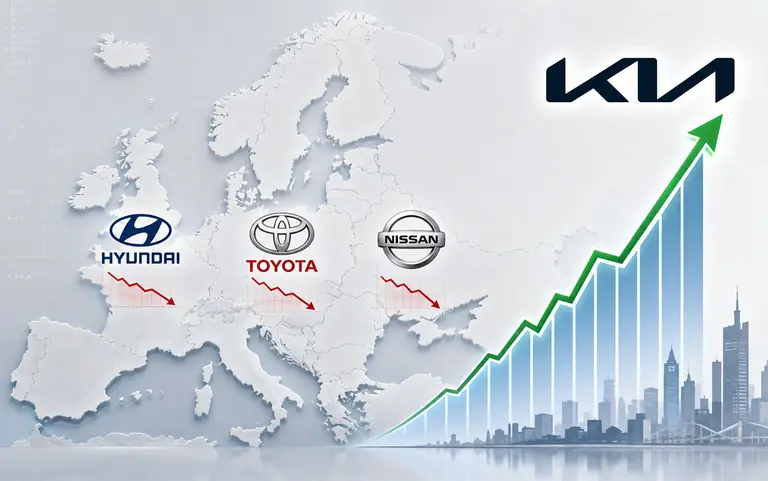





































In the global market, Toyota, Hyundai, and Nissan saw declining performance…Only Kia performed well.
In the global automobile market, performance differences among brands have become pronounced. As of last May, major automakers such as Toyota, Hyundai Motor, and Nissan recorded declining sales, while Kia continued its year-on-year growth trend and performed relatively well. In Europe, sales at traditional powerhouses including the Volkswagen Group, Stellantis, and Renault Group declined slightly, while Ford posted a significant drop of more than double digits.
Toyota’s global sales as of last May fell approximately 7.2% compared to the same month last year. The regions with the largest declines were China and the Middle East. In the Chinese market, price competition from domestic electric vehicle and hybrid manufacturers weakened Toyota’s competitiveness, and even its hybrid models, traditionally a strength, failed to shine.
The decline in the Middle East market is interpreted as a result of geopolitical risks and oil price fluctuations. Generally, rising oil prices are a positive factor for fuel-efficient hybrid vehicles. However, in an environment like the recent one where oil prices fluctuate sharply in the short term, consumers tend to delay vehicle purchases altogether.
Hyundai Motor also saw its global sales decline in May, by approximately 7.7%. For Hyundai, the impact of production reductions due to parts supply disruptions was greater than simple demand softening. The decline in domestic sales was also larger. However, in the U.S. market, sales of certain SUVs and electrified models held up, so this should be viewed as a short-term production and supply issue rather than a decline in brand competitiveness.
Nissan faces considerable structural burdens. Its global sales in May fell by more than 10%. Nissan has recently adjusted some of its electric vehicle plans and launched cost-cutting measures in an effort to defend profitability.
In contrast, Kia saw its global sales increase during the same period. Kia’s strong performance was driven by overseas sales, with its SUV-focused lineup including the Sportage, Seltos, and Sorento, along with electric and hybrid models, selling in a relatively balanced manner.
The European market atmosphere is also unfavorable. The market appears to be growing, centered on electrified vehicles, but the problem is that the source of growth is rapidly shifting from established large automakers to Chinese brands and Tesla. In particular, budget-market consumers do not weigh the performance and reliability that have long been strengths of traditional European cars. As a result, in May European sales, the Volkswagen Group fell 3.0%, Stellantis 2.3%, and Renault Group approximately 1.0%.
Ford’s decline is somewhat serious. Its May sales in Europe fell by more than 28%, and Ford’s slump is not due to short-term market downturn but to changes in its product lineup. The discontinuation of passenger car models familiar to European consumers, such as the Fiesta, Mondeo, and Focus, is the reason for the poor performance. Ford attempted to shift toward SUVs, commercial vehicles, and electric vehicles, but in the meantime, some of its existing customer base is interpreted to have moved to Volkswagen, Renault, Stellantis, Hyundai-Kia, and Chinese brands.
The variable is oil prices. Rising oil prices increase consumers’ maintenance cost burdens while also driving up inflation and interest rate pressures. In such cases, more consumers delay the timing of vehicle purchases. Conversely, if oil prices fall rapidly, demand from consumers looking to switch to electric or hybrid vehicles could decline. In an environment like the recent one, where oil prices fluctuate sharply depending on Middle East conditions, automakers also find it difficult to forecast demand.
The key going forward will be how automakers manage the ratio of their electric vehicle, hybrid, and internal combustion engine lineups. While the EV market is growing, the pace varies significantly by region, making hybrids likely to remain a practical alternative for the time being. Combined with oil prices, exchange rates, tariffs, and price pressure from Chinese manufacturers, the gap among brands in the global automobile market is likely to widen further.