












































Roskomnadzor and CO: How Remote Engine Start Can Lead to a Fine or Ruin a Driver
Most of us have long been accustomed to starting a car remotely to warm it up in winter and cool it down in summer. It is especially convenient to do this not with a key fob, but using a phone, for which distance is not an obstacle. However, sometimes modern technology can play a cruel trick on a car owner.
Remote start via a 433 or 868 MHz radio channel from an alarm key fob is gradually becoming a thing of the past. In urban conditions, it is almost always a lottery: will the range be enough or not? Much more convenient is an alarm system with a SIM card and start via a mobile app, or if mobile internet is acting up, a simple keyboard command: dial the car’s number as for a voice call, press a couple of digits, and the engine starts.
However, there is one problem. Probably not too relevant for residents of megacities, but quite acute for the other three-quarters of our country’s population who still have the opportunity to own a personal garage. This problem is cellular communication, necessary for remote start.
GSM Amplifiers
In concrete, brick, and especially metal garage boxes, there is often no signal, or it is unstable, at a level from zero to one bar on the scale. And communication is needed both for the aforementioned remote start and for regular internet, which is often used during car repairs: sometimes you need to look at an “exploded view diagram,” sometimes read other people’s blogs on repairing similar models and components.
To solve the problem, car owners have recently begun using so-called GSM amplifiers, also called picocells, GSM repeaters, and other terms. These devices are sold on any marketplace and cost on average from 6,000 to 10,000 rubles. Previously, the main buyers of such equipment were summer residents suffering from weak networks in remote gardening communities, but now car owners with garages have joined them. In many garage cooperatives on the outskirts of populated areas, the quality of mobile networks was already mediocre, and today cellular operators sometimes even adjust the coverage sectors of their antennas in real time, reducing signal strength in locations where there are formally no people and communication seems unnecessary.
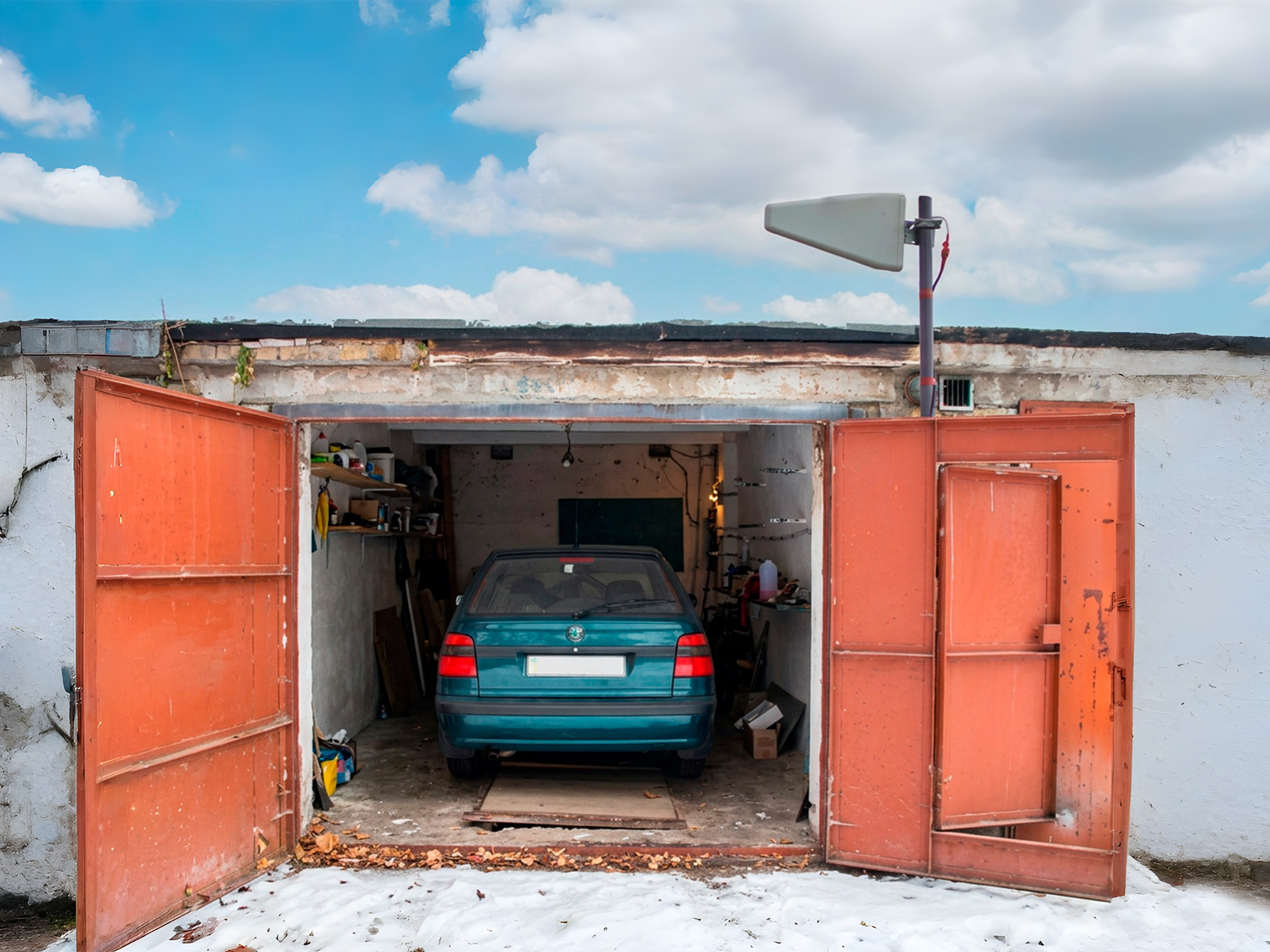
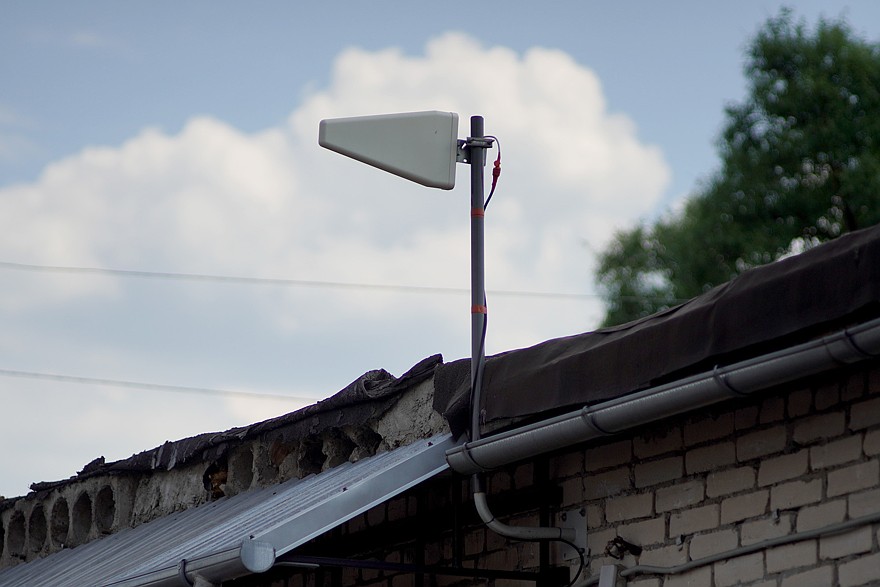
A GSM amplifier consists of a small amplifier unit box, powered by an adapter plugged into a socket, and two antennas – receiving and transmitting. The transmitting antenna is placed indoors where the phone cannot see the network, and the receiving antenna is placed on the roof, on a small mast-stand made from a piece of pipe, where it catches a weak but still somewhat recognizable signal from the cellular operator’s network. The antennas are often enclosed in plastic housings to protect them from precipitation and birds and look like white triangles or conical pyramids.
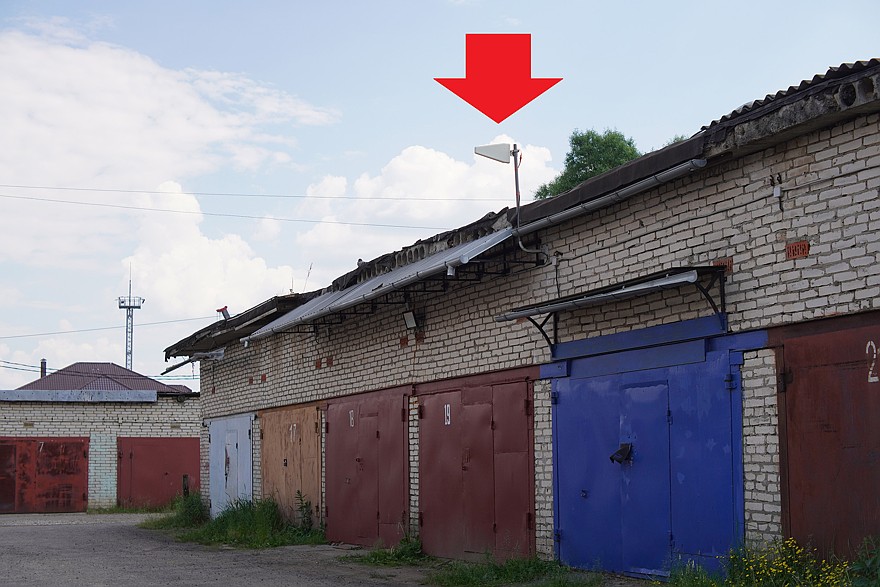
When the external receiving antenna is correctly oriented towards the cellular operator’s base station, this works quite well. However, there is one nuance: such devices are not entirely legal, if not completely illegal. And their integral part – the characteristic, recognizable, and visible-from-afar antenna – is a natural indicator of a violation, by which cunning car owners can be easily identified by the relevant authorities.
The legal basis for using such equipment was clarified for us by the Federal State Unitary Enterprise “GRChTs” – the Main Radio Frequency Center of Roskomnadzor.
Corr.: Is the use of such equipment legal? – Only cellular operators can legally use low-power repeaters and low-power base stations, and exclusively within the service areas of base stations operating according to permits. Only cellular operators or their accredited (contractor) organizations can install this equipment, after which the equipment must be registered with Roskomnadzor. Corr.: Do such amplifiers affect the standard equipment of cellular operators? – Self-installation of repeaters usually occurs without ensuring electromagnetic compatibility with the operators’ equipment. In such cases, repeaters can cause unacceptable interference to base stations and subscriber devices (phones). As a result, communication quality sharply deteriorates: speech intelligibility decreases, data transfer speed drops, and connection breaks occur. If the repeater is installed by a cellular operator or a specialized authorized organization, there is no negative impact on cellular networks, since the repeaters are configured in accordance with permits. Corr.: What liability do citizens face for using them? – The Federal State Unitary Enterprise “GRChTs” of Roskomnadzor conducts activities to identify illegally installed repeaters throughout the entire territory of the Russian Federation on an ongoing basis, as well as upon requests from cellular operators whose base stations experience interference from such repeaters. Materials regarding individuals and legal entities using repeaters without permits are sent to the territorial bodies of Roskomnadzor. In accordance with Article 13.4 of the Code of Administrative Offenses, the department has the authority to bring violators to administrative responsibility.
Article 13.4 of the Code of Administrative Offenses of the Russian Federation penalizes violations of the rules for using the radio frequency spectrum and operating radio-electronic devices. Installation of radio-electronic devices and high-frequency devices by citizens is punishable by a fine of up to 1,500 rubles (up to 30,000 rubles for legal entities) with confiscation of the devices. Use of such devices is punishable by a fine of up to 4,500 rubles for citizens and up to 60,000 rubles or suspension of activities for 90 days for legal entities.
Worse than a Fine
For those who are not afraid of anything or rely on the typical Russian “maybe it’ll be fine,” the issue of carbon monoxide danger in closed garages when warming up a car via remote start should be addressed separately.
Undoubtedly, it is best to warm up the car outdoors, guaranteed to avoid any troubles associated with hazardous emissions. But, no matter how you look at it, it is often necessary to keep the car in the garage and start it remotely from a smartphone to arrive at an already warmed-up engine and drive off immediately, without wasting time. Especially in winter. Therefore, you need to protect yourself from carbon monoxide – remembering that it is odorless and has almost the same weight as air, mixing with it quickly and fairly evenly, forming a deadly concentration.
It is relatively safe to warm up a remotely started car in a closed garage box overall, only if you ensure the exhaust gases exit outside the gate. For this, a hose is needed. Ideally, a thick-walled rubber reinforced hose (also known as “dourite”), but sometimes a hose from an old vacuum cleaner can suffice. The end of the hose is led outside through a round hole in the gate leaf, a U-shaped cutout in the lower edge of the leaf, or a hole in the brick wall drilled with a hole saw. Moisture condensing from the exhaust will accumulate in the hose, which must be considered when choosing the routing path. When disconnecting the hose from the muffler, you need to pour out the accumulated water, and if it is the cold season and the water has partially frozen, remove the ice mechanically, for example, by whipping the hose against the wall once or twice.
It is also highly advisable not to forget to turn on the air recirculation in the cabin when putting the car in the garage, so that exhaust leaks from the loose connection between the hose and muffler or from leaks in the joints of an old exhaust system are not sucked into the cabin. You could even turn off the cabin fan altogether. And in any case, when entering a garage where a running car is parked, it is advisable to hold your breath while you open the gate leaf. Although, of course, it is best to do without all of this – both without starting in the garage and without using illegal radio transmitting equipment.